Read the Street: What a City's Surfaces Are Quietly Telling You
Most travelers arrive in a new city with their phones already open, hunting for the top-rated taco spot or the most-tagged mural wall. Nothing wrong with that. But here's something worth knowing: the neighborhood itself has already been talking since the moment you stepped off the train or out of the rideshare. You just have to know what to look for — or more accurately, what to feel for.
The physical texture of a city is one of its most honest forms of communication. Smoother isn't always better. Rougher isn't always neglect. And once you start paying attention to what's underfoot and all around you, you'll never experience a new place the same way again.
Start at the Ground Level — Literally
Sidewalks are where the story begins. In older American cities like Philadelphia, Boston, or New Orleans, you'll still find brick-laid walkways that have been heaving and settling for over a century. Those uneven, slightly treacherous surfaces aren't a failure of city maintenance — they're evidence of a neighborhood that has been lived in continuously. Bricks shift because tree roots grow. Tree roots grow because people planted trees and stuck around long enough to see them mature.
By contrast, a freshly poured, perfectly level concrete sidewalk in a neighborhood that didn't have one five years ago is a different kind of signal. It might mean investment and improvement — genuinely good things. Or it might mean the neighborhood is being prepped for a different kind of resident entirely. Context matters. Look at what's sitting on top of that new sidewalk: are the storefronts occupied by longtime locals or freshly opened concept boutiques?
Cracked pavement with weeds pressing through the joints is often read as blight, but it can also mean a block that's been left alone long enough to develop real character — the kind of block where a third-generation hardware store or a decades-old Dominican lunch counter survives because no one's raised the rent yet.
Run Your Hand Along the Wall
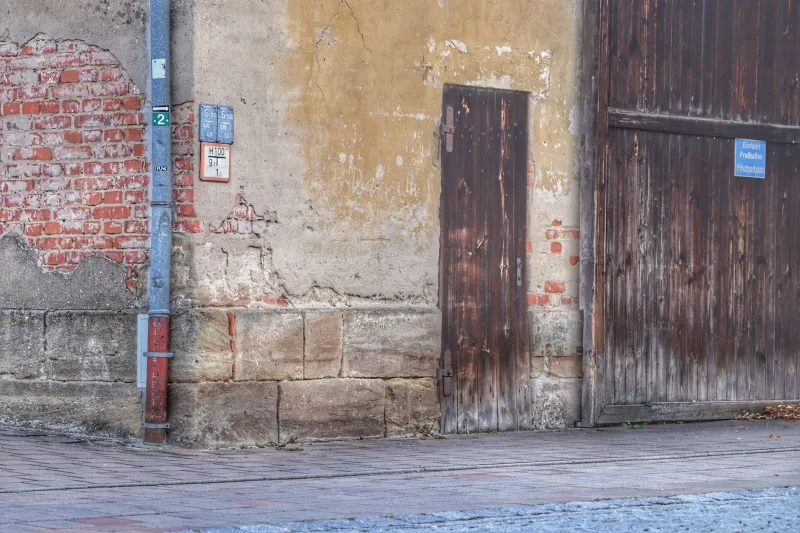
Building facades are a neighborhood's résumé. Exposed brick that's been painted over six times carries a different energy than exposed brick that's been sandblasted clean and sealed for aesthetic effect. The first version has history. The second has a story someone chose to tell.
In cities like Chicago, Detroit, and Baltimore, you'll find warehouses and row homes where the facade materials themselves are a timeline — limestone at the base from the original 1890s construction, brick repairs from the 1940s, a concrete patch from the 1970s, and fresh mortar pointing from last year. That layering is priceless. It means the building survived every economic cycle the neighborhood went through, and someone always cared enough to patch it up rather than tear it down.
Glass-and-steel facades, on the other hand, tell you almost nothing about a place's history — they tell you about its ambitions, which is useful information too, just a different kind.
Tile work is another underrated tell. Decorative tile on storefronts, entry vestibules, and old diner counters is incredibly expensive to reproduce authentically. When you see it intact — not reproduced, not restored with mismatched replacements, but genuinely original — you're looking at a block that hasn't been gutted and rebuilt. That's increasingly rare, and it's worth pausing over.
The Condition of Public Furniture Tells You Everything
Park benches, bus shelters, public drinking fountains, playground equipment — these are the things a city invests in when it believes a neighborhood deserves investment. And they're the things a city quietly lets deteriorate when it doesn't.
A bench with armrests installed in the middle specifically to prevent lying down is a policy decision disguised as furniture. A drinking fountain that works is a small but meaningful commitment. A bus shelter with actual walls and a roof instead of just a sign bolted to a pole says something about whether the city thinks the people waiting there matter.
This isn't about judging cities harshly. It's about reading them accurately. When you're trying to figure out whether a neighborhood is genuinely thriving or performing thriving for an outside audience, look at the public infrastructure that serves everyday residents rather than visitors. Those are the investments — or the absences of investment — that don't lie.
Noise and Texture Work Together
Here's something you might not expect in an article about surfaces: texture affects sound, and sound reinforces what you're feeling underfoot. Cobblestone streets amplify footsteps and wheel noise in a way that makes a neighborhood feel older, denser, more layered with time. Wide, smooth, recently resurfaced roads absorb sound differently — they can make a block feel almost eerily quiet, which in some neighborhoods signals emptiness and in others signals wealth.
Old Chicago alleys paved with brick and lined with garage doors that have been painted and repainted for decades have a specific acoustic quality that newer construction simply can't replicate. Same goes for the narrow streets of the French Quarter in New Orleans, where the combination of worn stone, plaster walls, and wrought-iron balconies creates a sound environment that feels like it's coming from 1890 even when a jazz band is playing something recorded last year.
Pay attention to what surfaces do to sound around you. It's part of the texture experience even if it's not something you can touch.
What Authenticity Actually Looks Like on the Ground
Travelers talk a lot about wanting "authentic" experiences, but authenticity is hard to define when you're standing in a city you've never visited. Here's a practical shortcut: look for surfaces that show repair rather than replacement.
A storefront window that's been reglazed three times. A metal door with visible weld marks from where a hinge was fixed rather than replaced. A sidewalk where someone poured a fresh concrete patch that doesn't quite match the surrounding gray. These are signs of a place that's been maintained by people who have a long-term relationship with it — owners, tenants, city workers who've been on the same route for twenty years.
Replacement is what happens when a neighborhood turns over quickly. Repair is what happens when people stick around.
That's not a moral judgment. Sometimes replacement is necessary, and sometimes turnover brings genuinely good things. But if you're trying to find the parts of a city that have real roots — the places where the food is good because the cook has been making that dish for thirty years, not because a consultant optimized the menu — follow the repairs. They'll take you there almost every time.
How to Practice This Anywhere
You don't need a special trip to start developing this skill. Try it in your own city first. Walk a block you know well and look at it like a stranger would. What does the pavement tell you? What's the oldest surface you can find? What's been replaced recently, and why?
Then take it somewhere unfamiliar. Before you check any reviews or ask for any recommendations, spend fifteen minutes just walking and touching and observing. By the time you pull out your phone, you'll already have a feel — literally — for whether this is a neighborhood that's been shaped by the people who live there or one that's been designed for the people passing through.
The best cities reward that kind of attention. And the best neighborhoods? They've got the worn edges to prove it.