Spine Out: Why Indie Bookstores Are the New Town Square
There's a moment that happens in a great independent bookstore. You're reaching for something off a staff picks shelf, a stranger next to you says "oh, that one wrecked me," and suddenly you're twenty minutes deep into a conversation about grief, or road trips, or the specific loneliness of living in a big city. You didn't plan it. Nobody facilitated it. It just happened — the way the best things in any city always do.
That moment is not an accident. It's architecture. And the smartest indie booksellers in America have figured out how to build spaces where it happens over and over again.
The Comeback Nobody Saw Coming
A decade ago, the obituaries for independent bookstores were practically pre-written. Amazon had the prices. Big box chains had the square footage. E-readers were supposedly going to make the whole physical book thing feel quaint. And yet here we are, with indie bookstore numbers in the US actually growing — the American Booksellers Association reported membership increases for several consecutive years heading into the mid-2020s, a trend that defied nearly every prediction.
What turned the tide wasn't stubbornness. It was reinvention. The shops that survived — and the ones opening fresh in neighborhoods from Portland to Pittsburgh — figured out something crucial: they weren't just in the book business. They were in the belonging business.
More Than a Shelf
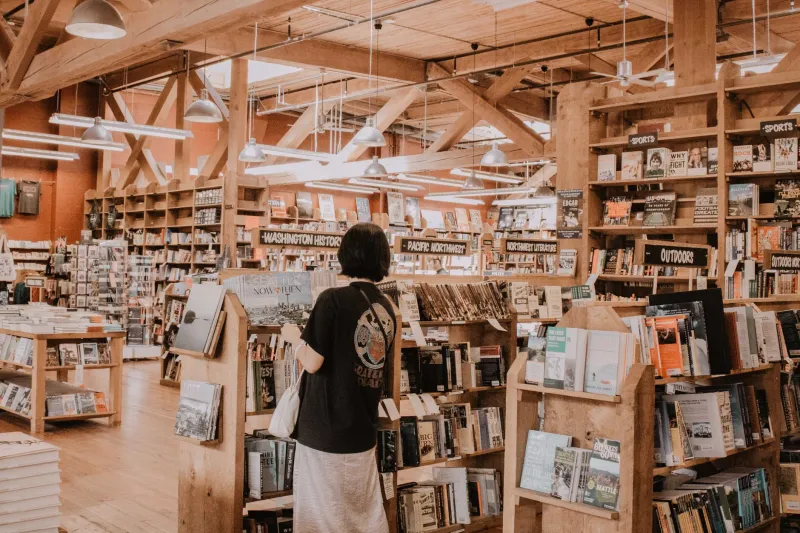
Walk into a place like Powell's Books in Portland, Oregon, and the sheer scale of it hits you first — a full city block of floor-to-ceiling shelves, color-coded rooms, and that particular smell (you know the one) that's half paper, half possibility. But even in a massive operation like that, what keeps people coming back isn't the inventory. It's the feeling that someone who actually cares about books decided what goes where.
That curatorial instinct is what separates the great indie shops from everything else. Staff recommendation cards handwritten with genuine opinions. Sections organized around ideas rather than just genres. A travel section that puts a novel set in Oaxaca right next to a guidebook to Mexico, because of course it does.
Smaller shops have pushed this even further. Semicolon Bookstore in Chicago's West Town neighborhood built an entire identity around community before the first book hit a shelf — its owner, Danielle Mullen, designed the space as a gathering point from day one, with events, local partnerships, and a curatorial voice so specific that browsing there feels like getting a recommendation from a friend who reads more than anyone you know.
The Event Economy
Here's where indie bookstores have quietly pulled off something remarkable: they've become the event venues that cities didn't know they needed.
Author readings are the obvious play, but the best shops have gone well beyond that. Book clubs that meet monthly and actually fill seats. Writing workshops in the back room on Tuesday nights. Release parties that double as neighborhood block parties. Poetry slams. Trivia nights themed around literary genres. Kids' story hours that bring in young families and create habits that last a lifetime.
Word Up Community Bookshop in Washington Heights, Manhattan, has run on a volunteer model and community programming that makes it feel less like a retail operation and more like a neighborhood institution. That's not a metaphor — it's genuinely what it is. The shop has become a place where the neighborhood processes itself, celebrates itself, and argues about itself, with books as the medium.
For travelers, this is gold. A well-timed visit to a city during a bookstore event drops you directly into the local cultural conversation in a way that no bar crawl or food tour can match.
Reading the Room (Literally)
The physical design of today's indie bookstores deserves its own appreciation. Where chain stores optimized for throughput — wide aisles, bright lights, get you in and get you out — indie shops are increasingly designed for staying.
Nooks with actual chairs. Window seats with actual light. Cats, sometimes. Coffee, often. A general vibe that says: you are welcome to be here for two hours and spend fifteen dollars. Nobody is tracking your dwell time.
This is not a small thing. In an era when most retail spaces are engineered to maximize transaction speed, a bookstore that invites you to sit down and think is a genuinely countercultural act. It's also, as it turns out, extremely good for business. People who linger buy more books. People who feel comfortable come back. People who meet someone interesting over a shared shelf tell other people about the place.
Why Travelers Should Prioritize the Local Bookstore
If you're visiting a city and you want to understand what it's actually about — not the Instagram version, not the Yelp version, but the real version — walk into an independent bookstore and spend an hour.
The local history section will tell you what the city is proud of and what it's still working through. The staff picks will give you a read on the neighborhood's personality. The events calendar on the door will show you what people care about enough to show up for on a weeknight. And if you strike up a conversation with whoever's behind the counter, you'll get restaurant recommendations, neighborhood intel, and probably a book you didn't know you needed.
Shops like Literati in Ann Arbor, Michigan, or Loyalty Books in Washington, D.C., or Parnassus Books in Nashville — the one co-owned by novelist Ann Patchett — have all become de facto orientation points for people arriving in their cities. Locals will tell you to go there. Not because they're tourist attractions, but because they're the places that make the city make sense.
The Neighborhood Effect
There's also a broader urban story happening here. Independent bookstores, it turns out, are remarkably good anchors for neighborhood commercial districts. They attract foot traffic without requiring the volume of a grocery store. They signal a certain kind of neighborhood character — curious, invested, not purely transactional — that draws other interesting businesses. They resist the homogenization that comes when every block starts to look like every other block.
City planners and economic development folks have started paying attention to this. A new indie bookstore opening in a neighborhood is increasingly read as a signal, not just of literary tastes, but of community health.
For travelers trying to find the most interesting parts of any city, that's genuinely useful information. Follow the bookstores. They tend to know where they're going.
Find Your Shop
Every city worth visiting has at least one. Some have a dozen. The best way to find yours is to skip the algorithm and ask a local — or just walk the neighborhoods you're drawn to and look for the handwritten signs, the cats in windows, the chalk boards out front with upcoming events.
When you find the right one, go in. Stay a while. Talk to someone. Buy something you didn't plan to buy.
That's the whole move. And it's one of the best things you can do in any city.